Cahors
From your gîte rental in Cabrerets, Cahors is about thirty kilometres away, which is roughly 35–45 minutes by road, depending on the season. It is one of the sites that travellers love the most visit the Lot.
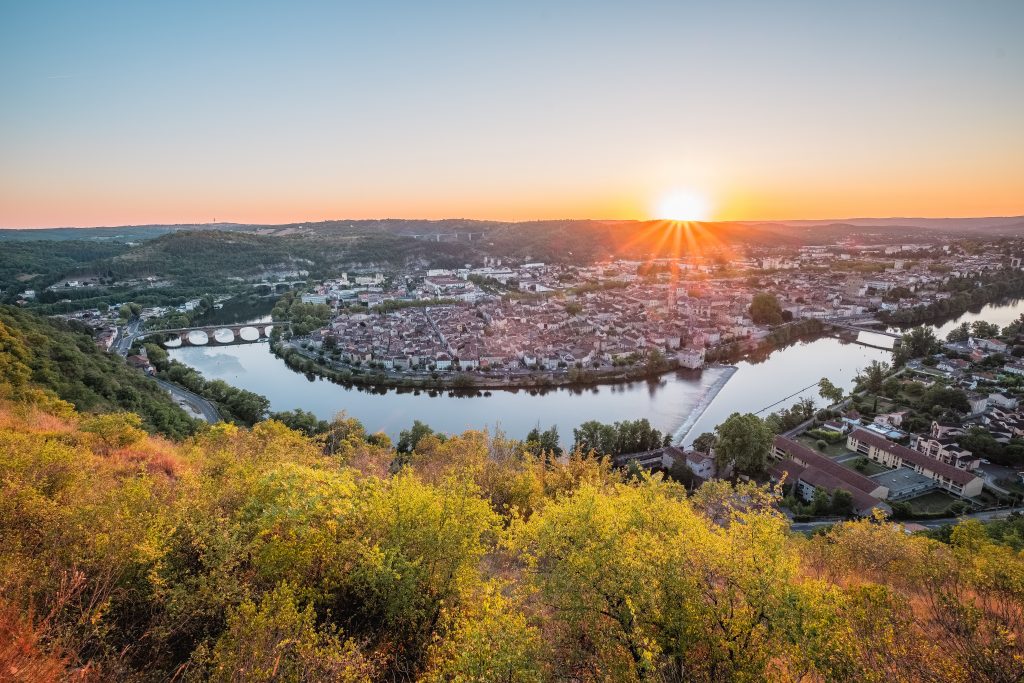
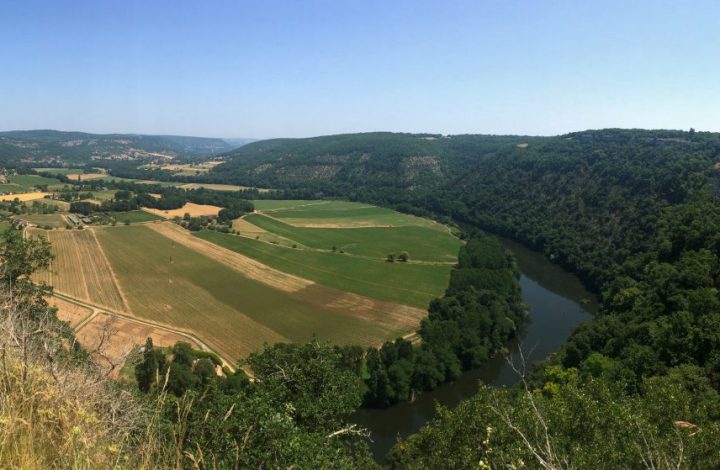
The town of Cahors is nestled in a bend in the River Lot, in a valley surrounded by hills. It is a town rich in history and art, which is a pleasure to explore on foot thanks to its manageable size (around 20,000 inhabitants).
What to see in Cahors
There are 18 listed monuments in the town. There are many listed and unlisted sites to see and visit, including :
- The covered market.
- Cruise on the River Lot.
- Tourist train through the old town.
- The fortified Valentré bridge.
- La Barbacane.
- Tour Saint Jean, known as the Tower of the Hanged Men.
- 14th-century Sain-Berthélémy church.
- The Duèze Palace and the tower known as «Pope John XXII’s Tower».
- Saint-Etienne de Cahors Cathedral.
- The Gallo-Roman Arch of Diana gate.
- Maison henri IV or HOtel Roaldès.
- Church of Saint-Urcisse.
Further information is available on the website of the Tourism Cahors-Vallée du Lot.
Famous people from Cahors
- Pope John XXII (1244-1316), born Jacques Duèze.
- Clément Marot (1496-1544), poet.
- Léon Gambetta (1838-1882), politician.
Cahors and its Gallo-Roman origins
Its origins date back to Roman times, when it was known as Divona Cadurcorum and referred to a spring said to be miraculous. Its resurgence is situated near the famous Valentré Bridge.
Cahors used to export as far as Rome fabrics from linenand the wine. This vineyard was created before 50 BC.
A aqueduct supplied the town with water from Vers, and indeed, remains of it can still be seen in the commune of Laroque-des-Arcs.
Numerous Gallo-Roman buildings have been found:
- from villas of the time and their mosaics,
- from temples,
- a theatre which welcomed over 6,000 spectators,
- a great amphitheatre,
- a basilica,
- or even thermal baths (you can see the’Arch of Diana which is a listed historic monument).
A disputed and plundered heritage
Besieged on several occasionsThe city of Cahors was notably contested by
- Julius Caesar,
- King Theodeberg I of the Franks,
- as well as Henry IV, King of Navarre,
- then the Englishman Richard the Lionheart,
- and later the Black Prince.
The various Gallo-Roman monuments described above were looted and destroyed over time.
Bishop Saint Didier, also known as Saint Géry, had the first cathedral built in 650, along with a city wall (corresponding to the present-day Boulevard Gambetta). Stones from the ancient monuments were used for the reconstruction.
But Cahors was pillaged again! This time by the Saracens in 732, then by the Vikings and Magyars. (Finno-Ugric people from the Danube region).

The Cadurcian Middle Ages prospered
Although only ruins remain of the former splendour of the town of Cahors, successive bishops enabled the city to be rebuilt, and its newfound prominence. At that time, it was an important and prosperous Catholic city.
Cahors developed mainly during the Middle Ages. At that time, it played a major role throughout Europe in both trade and finance.
In the 14th century, Pope John XXIIelected in 1316 and whose family had settled in Cahors, was generous to the town, which still bears many traces of his generosity.
In particular, in 1331 he founded the University of Cahors, one of the first universities in France, which would later merge with the University of Toulouse in 1751.
During the Hundred Years' War (1337-1453), the town spent some time under English rule.
The Renaissance in Cahors
During the Renaissance, the town of Cahors continued to flourish in both industry and craftsmanship.
The Cahors vineyards However, it faced competition from Bordeaux wines, which were supported by the English.
In 1580, Henry of Navarre (then Henry III) laid siege to and took Cahors, a wealthy Catholic town, during the 7th War of Religion.
From the 17th to the 19th century
The’University of CahorsOne of the oldest in France, this farmhouse dates back to the 17th century.
Then, in 1808, the Lot department lost a large part of its surface area when the creation of Tarn-et-Garonne.
Le lycée Gambetta, a legacy of the Jesuit school, nevertheless brings cultural prestige to the town, having produced numerous lawyers, poets, marshals of the Empire, eminent doctors, politicians and journalists.
This secondary school is named after Léon Gambetta, a lawyer born in Cahors who opposed Napoleon III.
20th century
During the Second World War, Cahors was initially in unoccupied territory. Then the German army took control on 11 November 1942. By early 1944, there were no fewer than 400 German soldiers in Cahors!
La Resistance began to organise as early as 1940, with numerous groups such as the Secret Army, the Combat Movement, the Railway Workers’ Resistance-Fer, the PTT Resistance, the Froment groups, the Army Resistance Organisation, Catholic Resistance, Francs-Tireurs et Partisans, the Corps-Francs Pommiès, Libérer and Fédérer…
In 1949, the town declared itself «Citizen City of the World»: Cahors Mundi. It was the first town to declare itself as such. André Breton, the ‘pope’ of Surrealism, attended the first anniversary celebrations in 1950. This marked the beginning of a movement that would go on to bring together around a thousand localities across 13 countries.